New Offer
Receive [your product here]
Describe what benefits the customer will get from your offer.


Written by Philip Ogina
Gold traded near $4,500 per ounce on Thursday, struggling to extend recent gains as markets grappled with conflicting signals surrounding the ongoing conflict between the United States and Iran.
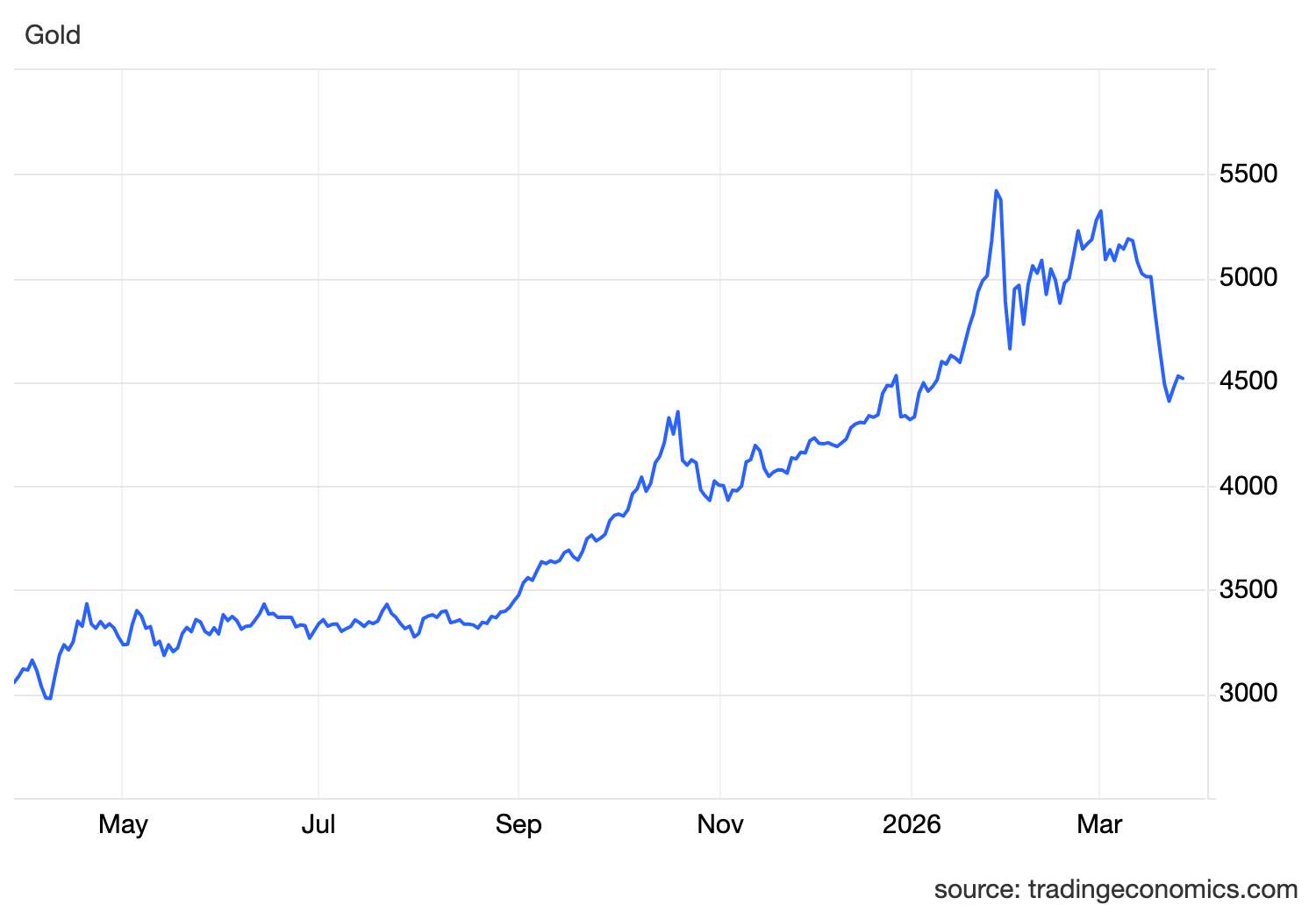
On one hand, Washington has indicated that diplomatic efforts are underway, with reports suggesting a detailed proposal has been sent to Tehran aimed at de-escalating tensions and restoring normal shipping conditions through the Strait of Hormuz. On the other hand, Iran has firmly rejected the prospect of negotiations under current terms, reiterating its stance on maintaining sovereign control over the strategic waterway and setting its own conditions for any ceasefire.
This divergence has left markets in a state of uncertainty. At the same time, the United States has deployed additional troops to the region, raising concerns about the potential for further escalation and even a ground conflict, which continues to underpin demand for safe-haven assets.
However, gold is no longer reacting in a straightforward way to geopolitical risk.
The key shift this month has been the re-emergence of inflation as the dominant macro driver. Surging energy prices, triggered by disruptions linked to the Iran conflict, have pushed inflation expectations higher and forced central banks to adopt a more cautious, and in some cases more hawkish, stance on monetary policy.
This has created a more complex environment for gold. While geopolitical tensions would typically support bullion, rising inflation expectations have pushed bond yields higher and strengthened the dollar, both of which tend to weigh on non-yielding assets.
As a result, gold is now trading at the intersection of two opposing forces. Safe-haven demand is providing support, but the shift in rate expectations is limiting upside momentum.
The broader central bank backdrop reinforces this dynamic. Policymakers across major economies are increasingly signaling that rate cuts may be delayed or limited if inflation remains elevated, particularly in an environment where energy prices continue to act as an external shock.
For markets, this represents a structural change in how gold behaves. It is no longer moving purely on risk sentiment, but on the interaction between inflation, interest rates, and geopolitical developments.
Crude Slides as Markets Price De-escalation in Iran Conflict
Gold and Oil Steady as Trump Extends Iran Deadline and Markets Reprice Risk
Session expired
Please log in again. The login page will open in a new tab. After logging in you can close it and return to this page.