New Offer
Receive [your product here]
Describe what benefits the customer will get from your offer.


Written by Philip Ogina
The Japanese yen stabilized around 159.6 per dollar on Tuesday, holding onto recent gains as markets reacted to increasingly firm signals from Tokyo that intervention remains on the table.
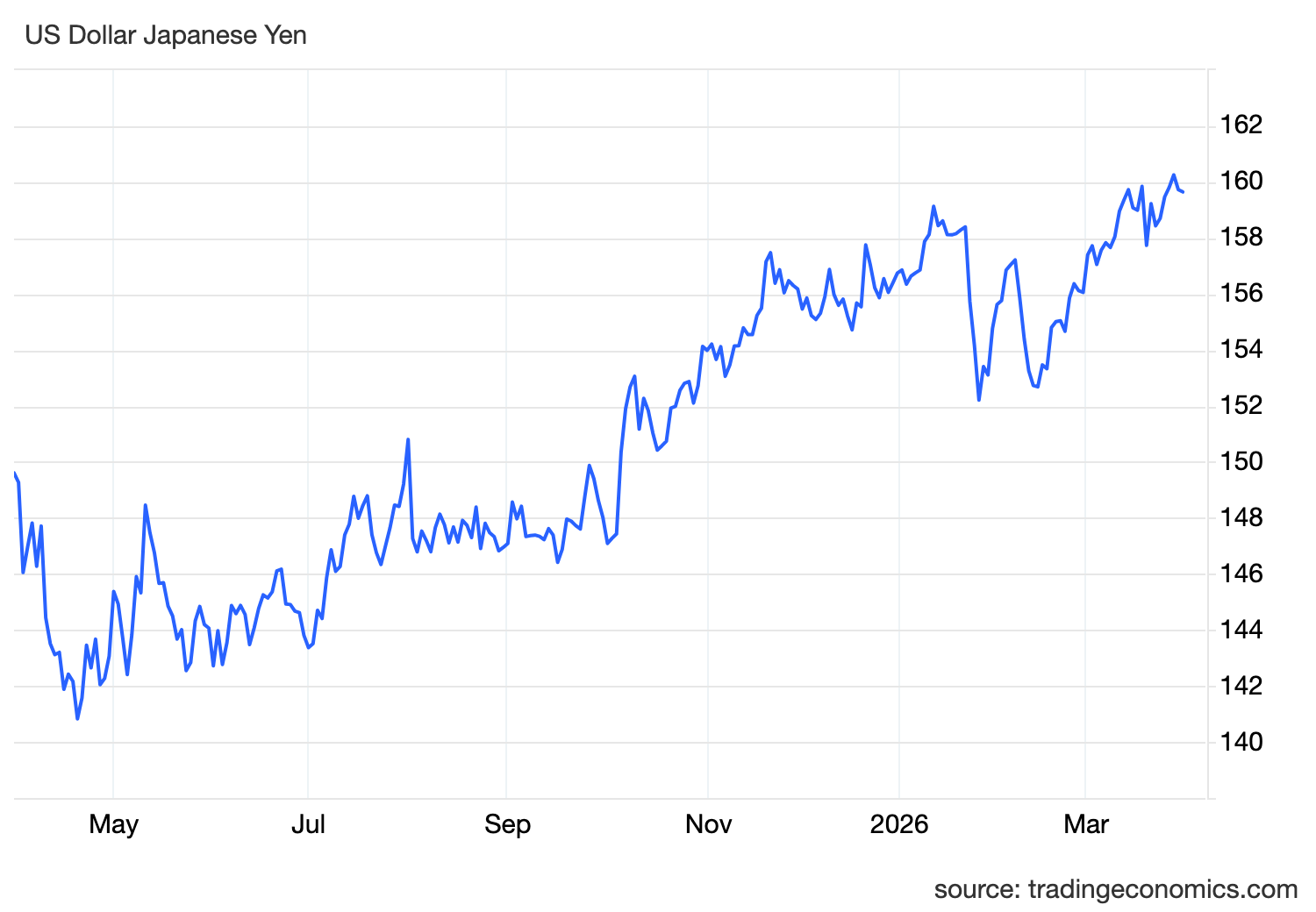
Officials stepped up their rhetoric after the currency weakened beyond the psychologically important 160 level, a threshold that previously triggered direct intervention in 2024. Top currency official Atsushi Mimura warned that authorities stand ready to act decisively, reinforcing similar comments from Finance Minister Satsuki Katayama.
That intervention risk has provided near-term support for the yen. However, the broader macro forces driving the currency remain firmly against it.
The key pressure point is oil.
Japan is one of the world’s largest energy importers, and the recent surge in oil prices linked to the Middle East conflict is effectively acting as a negative shock to its economy. Higher energy costs widen Japan’s trade deficit, weaken its external balance, and increase demand for foreign currency, all of which naturally pressure the yen lower.
At the same time, the dollar is benefiting from the same shock.
Rising oil prices are feeding into global inflation expectations, which is reducing the likelihood of near-term rate cuts from the Federal Reserve. That keeps US yields relatively elevated and continues to support the dollar across the board.
This creates a structural divergence.
Japan faces imported inflation and weaker growth due to higher energy costs.
The United States faces inflation risk but retains higher yields and stronger capital inflows.
That divergence is why USDJPY remains elevated despite intervention threats.
From a policy perspective, this puts Japanese authorities in a difficult position. While verbal intervention and the threat of direct market action can slow the pace of depreciation, they do not address the underlying drivers. Unless oil prices ease or the yield gap between the US and Japan narrows meaningfully, pressure on the yen is likely to persist.
This is also why the yen has not behaved like a traditional safe-haven currency during this crisis. Instead of strengthening, it has weakened, as the energy shock has outweighed its defensive appeal.
For markets, the 160 level remains critical.
A sustained break higher could force actual intervention, leading to sharp but potentially temporary reversals. However, unless the macro backdrop shifts, those moves may struggle to hold.
The broader takeaway is clear. The yen is no longer trading purely on risk sentiment. It is trading on energy dependence, yield differentials, and policy credibility.
Markets Face a High-Stakes Week as Oil, NFP and Inflation Reprice Everything
Oil Shock Constrains Fed: Why Geopolitics Just Delayed Easing
Session expired
Please log in again. The login page will open in a new tab. After logging in you can close it and return to this page.